Best Acme Tool Buying Guide — Black Friday Deals 2026
Acme-thread work can call for different checks: identifying pitch, covering a particular list of thread sizes, or checking the angle of a screw-cutting tool. These three gauges describe different approaches, so start with the task and the exact angle or coverage you need rather than treating them as interchangeable. The listings include a 30° gauge, two 29-degree options, and different ways of presenting pitch coverage. For Black Friday, compare the exact item and variant shown in the offer with the relevant details below; no promotion or price is assumed here. A clear match between the stated features and your job is more useful than the event label alone.
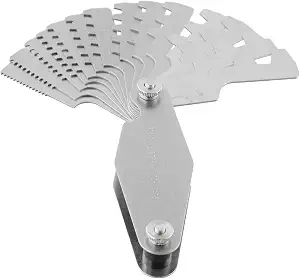
Best Overall is an editorial fit for shoppers who want one clearly specified gauge to consider across a stated pitch range. This listing gives a 30° thread angle, coverage from 2P to 20P, and a blade count of fourteen. Those details offer several concrete points to check against the thread and tool in front of you. They do not establish suitability for every Acme-thread task, so confirm that the stated angle and pitch format match what you need before choosing it.
The material is listed as quenched stainless iron. That is a material description, not evidence about service life, corrosion resistance, accuracy, or how the gauge behaves in a particular workshop. Likewise, the stated dimensions—5.91 x 1.97 x 0.79 inches—can help you judge whether the listed form is appropriate for your storage or work setup, but they do not reveal additional design details. If size or material is a deciding factor, use only what the exact listing says rather than filling in assumptions.
This option may be worth considering when your priority is a listed pitch range rather than a set presented as a series of thread sizes. Its 2P to 20P coverage is expressed differently from the inch-size entries on the other set, so compare the notation you use in your work before treating the options as alternatives. For Black Friday, check that the offer points to this exact gauge and verify that the angle, range, blade count, and material still match the item you intend to buy. The Best Overall label is an editorial selection among these featured products, not a claim of tested or market-wide superiority.
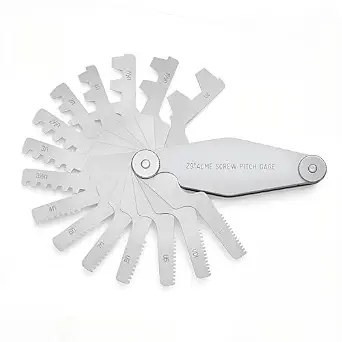
Best for Broad Listed Size Coverage describes this set’s most immediately useful distinction: it names a range of thread sizes in its specifications. The 16-piece set lists 1, 1-1/3, 1-1/2, 1-3/4, 2, 2-1/2, 3, 3-1/2, 4, 5, 6, 7, 8, 9, 10, 12 in. If your reference list uses those entries, check them one by one against the job rather than relying on the general impression that a larger set must cover what you need.
The listing describes a 29 Degrees ACME Screw Pitch Gauge set and says it measures internal and external screw threads with thread blades of varied size. That makes the stated measuring purpose relevant for someone who needs to assess both types of thread. The material is stainless steel, and the scale is described as laser engraved and durable, with the listing saying it is not easy to wear. Those are the provided descriptions; they do not establish a particular accuracy level or guarantee how the scale will hold up in a specific work environment.
This format could suit a shopper whose main constraint is matching a known inch-size list, while someone working from a pitch notation may prefer to compare the other listings’ stated coverage instead. For Black Friday, inspect the exact set and its included-size details in the offer, especially if you are buying to address a specific measurement task. The label highlights the breadth of the sizes explicitly listed here; it does not claim that every possible size is included or that this set outperforms the alternatives. Let the job’s required entry, angle, and measurement purpose decide whether the described coverage is relevant.
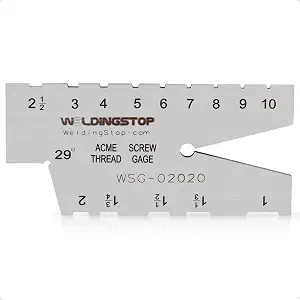
Best Budget is the editorial label for this single-piece format, not a statement about its price. The listing describes a 29 degree stainless steel Acme thread gauge as a single piece and gives a range of 1-10TPI. It also lists pitches as 1,1-1/3,1-1/2,1-3/4,2,2-1/2,3,4,5,6,7,8,9,10. If your notes or work instructions use those entries, compare them directly with the stated list before deciding whether this one-piece option covers your intended check.
Its stated use is measuring thread and external thread tooth pitch. The listing also calls it a standard gauge for checking the angle of screw-cutting tools. That makes the angle-checking purpose a meaningful distinction for someone choosing a gauge around tool setup or a thread-related inspection. The description does not specify internal-thread measurement, so keep your decision tied to the uses that are actually stated rather than assuming a broader purpose.
All scales on the gauge are described as laser engraving, and the material is stainless steel. These details may matter when deciding which listed construction and marking approach you prefer, but they do not provide a basis for claims about precision, lifespan, or performance. During Black Friday, compare the exact single-piece item in the offer with your needed angle, TPI range, pitch entries, and intended check. This option may appeal if the stated purpose and list align without needing the explicitly described 16-piece format; that is a difference in listed format, not proof of a lower price or better value. The Best Budget label is limited to this editorial framing.
Key specs
Type
The 29 degree stainless steel acme thread gauge is a single piece type
Use
it is applied to measure thread and external thread tooth pitch.
Range
The acme thread gauge range:1-10TPI
Pitch
the pitch:1,1-1/3,1-1/2,1-3/4,2,2-1/2,3,4,5,6,7,8,9,10.
Tool check
Standard gauge for check the angle of screw cutting tools
Scale marking
All the scales on the acme screw gauge are laser engraving
Start with the notation on your work order
Before comparing products, look at how the required thread information is written down. One listing expresses its coverage as 2P to 20P. Another names a series of inch-size entries, while the single-piece gauge states a 1-10TPI range and separately provides a pitch list. These are not identical descriptions, and the records do not establish that one format converts directly into another. If you have a drawing, an existing part, or a shop reference, use its notation as your starting point and confirm the intended match with the product’s stated coverage.
This simple check can prevent a common shopping mismatch: choosing a gauge because its general name sounds right while overlooking the specific range or angle. Write down the measurement you need, the notation used, and whether you are checking a thread or a cutting tool. Then compare only the corresponding facts. If information on your work is unclear, do not treat a product listing as a substitute for identifying the required specification. Black Friday browsing can move quickly, but a pause to confirm the notation is more useful than choosing by the broadest-sounding description.
Angle deserves its own decision
The listed angles separate these choices in a practical way: one gauge specifies 30°, while the other two specify 29 degrees. That distinction should be checked against the angle required for your task rather than smoothed over because all three listings mention Acme threads. The available product facts do not say that the angles are interchangeable, nor do they say which angle any particular shopper’s job requires. Use the exact requirement from your work instructions or tool setup.
The purpose described for the single-piece option includes checking the angle of screw-cutting tools. The 16-piece set is described as measuring internal and external screw threads, and the first gauge provides its thread angle and pitch range. Consider which of those stated purposes resembles your job, then verify the angle independently. For Black Friday, do not let an event badge distract from this filter: compare the precise item and variant on offer, and make sure the angle shown there is the one you intend to buy.
Choose coverage that answers a real need
A long list is useful only when its entries correspond to the work you expect to do. The 16-piece option explicitly lists a sequence of thread sizes, so it gives a shopper a direct checklist to compare with known size requirements. The single-piece gauge instead states a 1-10TPI range and enumerates pitches. The remaining gauge specifies 2P to 20P and fourteen blades. Each description gives a different way to think about coverage; none supports a general conclusion that one will handle every task.
For occasional work on a known size, matching the listed entry may matter more than having a format that sounds broader. For varied tasks, you may want to examine each stated range or size list carefully and decide whether it corresponds to the measurements you actually encounter. Avoid counting listed entries as a proxy for real-world usefulness when the products describe coverage differently. During Black Friday, compare the exact specifications rather than assuming an offer on a set automatically provides the right coverage for your particular thread.
Let the stated purpose shape the format choice
These listings distinguish a single-piece gauge from a 16-piece set, but the format alone does not tell you which is more convenient. Consider what you need to check. If you specifically need a gauge described for checking screw-cutting-tool angle, the single-piece listing states that purpose. If you need to measure internal and external screw threads, the 16-piece set explicitly describes both. If your main selection criteria are the 30° angle and a 2P to 20P range, the first gauge gives those details directly.
Think through where the tool will be used, what measurement you need to make, and how you will identify the correct entry. These questions help translate a product description into a practical choice without guessing at portability, storage, handling, or results—details not supplied here. A format that matches your routine is not automatically the best fit for another person’s task. Black Friday is a good moment to compare options, but the product’s stated use should remain the deciding filter.
Read construction details without treating them as guarantees
Material and marking descriptions can help distinguish the listings, as long as you keep their meaning narrow. The 30° gauge is described as quenched stainless iron; the 16-piece set is made of stainless steel; and the single-piece gauge is also described as stainless steel. The set’s scale and the single-piece gauge’s scales are described as laser engraved. These facts identify what the listings say, but do not establish comparative durability, corrosion resistance, ease of reading, or measurement accuracy.
If those details matter for your work, check that they appear on the exact product variant in the Black Friday offer. Do not infer a missing feature from another option’s description, and do not assume that similar material wording means identical construction. The 16-piece set’s scale is described as not easy to wear and durable; retain that qualification rather than treating it as a guarantee of service life. Compare construction as one part of the decision, alongside angle, coverage, and stated purpose.
Make your Black Friday choice
A sound choice begins with the requirement you can verify: angle, pitch notation, listed size, or the task the gauge is described to perform. The three options offer different specification formats, so matching your job to the exact listing matters more than choosing by a broad label. On Black Friday, confirm the precise item and variant and review its stated details before proceeding; no particular price or promotion is assumed. The editorial labels can help orient your comparison, but they are not test results. Choose the gauge whose documented features answer your actual measurement need.